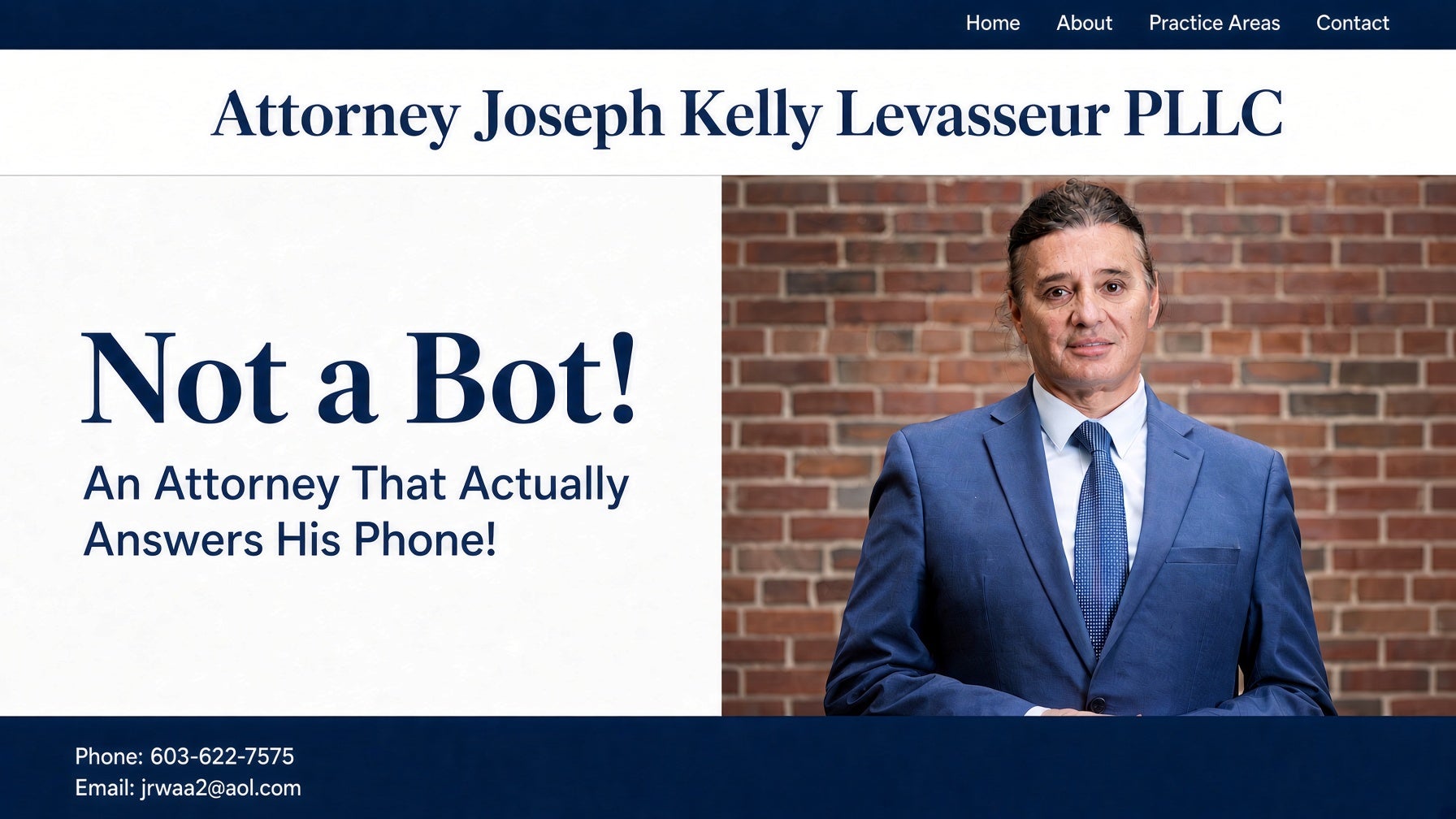
Not a Bot!™ When you call, Attorney Joseph Kelly Levasseur answers his own phone. Calls to the office ring through to his cell. No call center, no chatbot. If he is in court, leave a message and he will call you back himself. Tap to call 603-622-7575.
Free consultation.
Being accused of domestic violence can turn your life upside down in a single day. You may be ordered out of your home, kept from your children, and told to turn over your firearms, sometimes before you have had any chance to tell your side. Attorney Levasseur has practiced law in New Hampshire for 24 years and defends people accused of domestic violence, both in criminal court and at civil protective order hearings in the New Hampshire Circuit Court. His office is at 396 S Willow St in Manchester, and he serves clients across Hillsborough and Rockingham counties, southern New Hampshire, and northern Massachusetts residents facing cases in NH.
Served with a Restraining Order? What to Do Now
- Obey the order exactly, starting now. No calls, texts, social media messages, or messages through friends. Under RSA 173-B:5, VIII, you must follow a no-contact order even if the other person invites you to make contact. Only the court can change it.
- Turn over firearms and ammunition if the order says so. Temporary and final orders can require you to give all firearms and ammunition to police and bar you from buying or having them while the order lasts (RSA 173-B:4 and 173-B:5).
- Write down your hearing date. The court must hold a hearing within 30 days of the petition being filed or within 10 days of service on you, whichever is later (RSA 173-B:3, VII).
- Ask about an earlier hearing. If a temporary order was issued without you there, you can file a written request for a hearing, which must be held 3 to 5 business days after the clerk receives it (RSA 173-B:4, I). That can mean getting back into your home or seeing your children sooner.
- Do not talk about the case with police or post about it online. Anything you say can be used in the civil hearing and in any criminal case.
- Call a lawyer before the hearing. You have a right to present evidence and witnesses. Preparation matters.
The Protective Order Hearing
At the final hearing, the person who filed must prove abuse by a preponderance of the evidence, and the abuse must amount to a credible present threat to their safety (RSA 173-B:1 and 173-B:5). The court is not bound by the formal rules of evidence (RSA 173-B:3, VIII), so careful preparation and cross-examination are important.
If the order is granted, it can last up to one year. The petitioner can ask to extend it for good cause, first for one year and then for up to 5 years at a time, and you have the right to a hearing on an extension within 30 days (RSA 173-B:5, VI). A final order can affect where you live, custody and visitation, support payments, and your right to own firearms.
Getting your firearms back. Within 15 days before the order expires, you can ask the court to return your firearms. The court will hold a hearing, and police may not release them without a court order (RSA 173-B:5, X).
Stalking Orders
A person can also seek a civil stalking order under RSA 633:3-a, III-a. These orders use the same procedures, proof standard, and penalties as domestic violence orders under RSA 173-B, and can be extended the same way. They do not require a family or dating relationship. Stalking is also a crime, usually a class A misdemeanor, and a class B felony with a prior stalking conviction within 7 years (RSA 633:3-a, VI).
Charged with a DV Offense
Domestic violence under RSA 631:2-b covers conduct such as causing bodily injury or unprivileged physical contact, threats with a deadly weapon, or unlawful confinement against a family or household member or intimate partner. It is a class A misdemeanor, or a class B felony if a deadly weapon is used or threatened. Other common charges include criminal threatening, stalking, and violating a protective order.
- Violating a protective order is a class A misdemeanor that cannot be reduced to a lesser charge (RSA 173-B:9, III). Police must arrest and generally hold the person until arraignment (RSA 173-B:9, I).
- Bail conditions. After a DV arrest, the court usually sets bail conditions such as no contact with the alleged victim and staying away from the home. Violating them can lead to new charges and jail.
- Firearms. Under federal law, 18 U.S.C. § 922(g)(9), anyone convicted of a misdemeanor crime of domestic violence may not possess firearms or ammunition. A plea that seems minor can mean a lifetime federal gun ban.
- Enhanced penalties. A prior conviction for violating a protective order can raise later abuse offenses to a higher class (RSA 173-B:9, IV).
The State must prove every element beyond a reasonable doubt. Attorney Levasseur looks closely at the police reports, 911 calls, witness statements, injuries, and the history between the parties. False or exaggerated accusations happen, especially during breakups and custody disputes. You have the right to stay silent. See Should You Talk to Police in NH?
Out-of-State / Massachusetts Residents
If you live in Massachusetts or another state and are charged or named in a petition in New Hampshire, your case stays in the New Hampshire court where it was filed. A New Hampshire protective order is enforced throughout the state (RSA 173-B:13), and federal law generally requires other states to honor it as well. Attorney Levasseur can handle much of the case for you and will tell you which hearings you must attend in person. Because a no-contact order still applies to calls, texts, and social media from across the state line, get advice before you reach out to anyone involved.
Areas Served
Manchester, Nashua, Merrimack, Bedford, Goffstown, Hudson, Milford, Salem, Derry, Londonderry, Windham, Exeter, Hampton, Portsmouth, and the rest of Hillsborough and Rockingham counties, plus northern Massachusetts residents with cases in NH.
Domestic Violence and Restraining Order FAQs
How soon is the restraining order hearing?
Within 30 days of the petition being filed or within 10 days of service on you, whichever is later. Either side can ask for up to 10 more days for good cause (RSA 173-B:3, VII). If a temporary order was issued without you there, you can request a hearing within 3 to 5 business days (RSA 173-B:4, I).
Can I contact the other person if they reach out to me first?
No. A no-contact order applies even if the other person invites contact, until the court modifies it (RSA 173-B:5, VIII). Violating it is a crime.
Do I have to give up my guns?
Usually yes, for as long as the order lasts. Protective orders can require you to turn firearms and ammunition over to police and bar you from buying or having them (RSA 173-B:4 and 173-B:5). A domestic violence conviction can also bring a federal firearms ban under 18 U.S.C. § 922(g)(9).
How long does a final protective order last?
Up to one year. It can be extended for good cause, first for one year and then for up to 5 years at a time, and you have a right to a hearing on any extension (RSA 173-B:5, VI).
I live in Massachusetts. Does a New Hampshire order apply to me?
Yes. A New Hampshire order binds you wherever you live, and other states generally enforce it. Your case is handled in the New Hampshire court where it was filed.
How much does a consultation cost?
The first consultation is free. Fees for handling your case are explained in a written fee agreement you will review before deciding anything.
Talk to a Manchester Domestic Violence Defense Lawyer Today
Protective order hearings come up fast, and what you do in the first few days matters. If you have been served with a restraining or stalking order, or charged with a domestic violence offense in Manchester or anywhere in southern New Hampshire, call Attorney Joseph Kelly Levasseur at 603-622-7575 or visit our contact page. Office: 396 S Willow St, Manchester, NH.
Free consultation. You will talk to the lawyer, Not a Bot!™
This page is attorney advertising and provides general information, not legal advice. Laws described are current New Hampshire and federal law and may change. Reading it or contacting the office does not create an attorney-client relationship. Every case is different, and past outcomes do not predict future results.